
Presentation of the field
“Supplying humanity with mineral and energy resources, while managing the subsurface in a way that preserves our natural heritage”
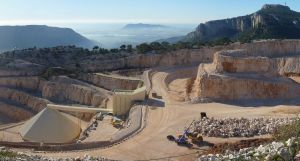
Today, just as in the past, humans cannot produce anything that does not come from the earth. We will not be able to do without mineral resources, the consumption of many of which is likely to increase even further. We will need to produce differently—and better—rather than produce less, but we will also need to recycle. The subsurface is also a valuable resource for land-use planning, as it frees up surface area. We now speak of underground urban planning and storage.
The area of excellence “Mineral Resources & Subsurface Development” thus covers four sectors of activity. The first is mining and quarrying, in which engineers will be called upon to explore, extract, and process natural resources in a responsible, reasoned, and collaborative manner. The second is tunnels and underground spaces, where engineers will be able to manage the geotechnical work necessary for the sustainable development of the territory and the urban subsurface. The third is natural underground reservoirs for storing liquids or gases, which engineers will be able to design and construct. And the fourth is recycling, which enables the production of alternative raw materials and thus helps preserve natural resources.
Four specialized tracks are offered, training nearly 70 students each year to “supply humanity with mineral and energy resources and develop the subsurface while preserving our natural heritage.”
4
Programs are offered in the area of excellence “Mineral Resources & Subsurface Development”
Generalist Engineer
The “Subsurface Engineering and Mineral Resource Management” track trains engineers to address the technological challenges posed by the supply of mineral raw materials and subsurface development. They are able to integrate economic, societal, and environmental considerations, utilize new digital technologies to make production systems smarter, and contribute to the development of the energy and digital transitions by providing all the necessary and useful resources.
This program thus covers four sectors of activity. The first is mining and quarrying, in which engineers will explore, extract, and process natural resources in a responsible, reasoned, and collaborative manner. The second is tunnels and underground spaces, in which engineers will be able to manage the geotechnical work necessary for the sustainable development of the land and the urban subsurface. The sector of natural underground reservoirs for the storage of liquids or gases, which engineers will be able to design and construct. And the sector of recycling, which enables the production of alternative raw materials and thus helps preserve natural resources.
This option provides access to careers in the production and marketing of mineral raw materials, the construction of underground structures or spaces, engineering in design firms, and technical, economic, or socio-environmental project management and consulting.
At the end of the program, students can choose from two modules designed to prepare them for future developments that will enable them to better leverage opportunities from both a technical-economic and an environmental-societal perspective.
- The “Connected and Scalable Career” module focuses on the digitization of production and marketing processes, as well as highly interoperable tools that will enable the optimized and systematic management of a production unit. The “Industry 4.0” operations of the future will be digital in terms of human-machine interaction and will place the user of these tools at the center of the system.
- The “Integrated and Responsible Mining” module focuses on integrating mining operations with their environment, their region, and their human, social, and socioeconomic context. The mining operations of the “4.0” future will be impact-free, respectful, and responsible at the local level, with beneficial effects on the local population. This is an essential prerequisite for gaining societal acceptance.
FRANÇOIS MANNÉ
Manager
ISERM
It's a program that really prepares you for the workforce, and the network is very strong and close-knit.
Pierre-Henri LOUP
GENERAL ENGINEER, UNDERGROUND ENGINEERING & MINERAL RESOURCE OPERATIONS
The “Subsurface Engineering and Mineral Resource Management” track trains engineers to address the technological challenges posed by the supply of mineral raw materials and subsurface development. They will be able to integrate economic, societal, and environmental considerations, utilize new digital technologies to make production systems smarter, and contribute to the energy transition by providing all the necessary and useful resources.
This program thus covers three sectors of activity. The first is mining and quarrying, where engineers will be called upon to explore, extract, and process natural or alternative resources in a responsible, reasoned, and collaborative manner. The second is tunnels and underground spaces, where engineers will be able to manage the geotechnical work necessary for the sustainable development of the land and the urban subsurface. It also covers the field of natural underground reservoirs for the storage of liquids or gases, which engineers will be able to design and construct. This track provides access to careers in the extraction and processing of primary or alternative mineral resources, engineering in design firms, and project management.
Program of the option :
The syllabi are currently being updated and are subject to change.
1:00 = 55 min
Geoscience - 46H
- Hydrogeology
- Geostatistics
- Rock Mechanics
Mineral Resources and Materials - 46H
- Issues Related to Mineral Resources
- Mineral Resources
- Construction Materials
Geotechnical works - 46H
- Soil Mechanics
- Earthwork
- Roads
Operations - 54H
- Quarry Operations
- Digital Transformation
- ICPE Regulations and Environmental Impact
Processing - 32H
- Felling
- Transport
- Mechanical processing - Processing scheme (Bruno)
Digital and Decision-Support Tools - 28H
- Coralis
- QGIS
- Decision-Support Tools
RTCE project: (Roads, Earthworks, Quarries, Environment) or R&D mission - 172H
The syllabi are currently being updated and are subject to change.
1:00 = 55 min
Geosciences - 30H
- Structural Geology
- The Mining Process
- Exploration
- Quarry Tour
Mining Methods - 44H
- Phasing and Planning
- Open-Pit Mining
- Underground Mining
ON-CAMPUS PROGRAM
Open-air construction work - 48H
- Blasting
- Loading and Transport
- Mechanical Processing
Underground Work - 52 hours
- Underground Structures
- Mechanical and Blasting Excavation
- Support Structures
- Water Injection
Environment and Society - 58H
- Mineral Processing
- Environmental Management
- Water and Treatment Residue Management
- Social Acceptability
- Characterization Method
Digital Tools - 27H
- Coralis
Technical Course: “Mining and Quarrying” — 210H
FRANÇOIS MANNÉ
Manager
Specialized training, Masters and Master's degrees
Specialised Masters in Mining and the Environment
MExCa specialized training, co-certified by UNICEM
- For further information
- Mail: francois.manne@mines-ales.fr
- Tel : + 33 04 66 78 56 63
Dual-Degree Program:
General Engineering & Master’s in Geosciences (University of Montpellier)
Students can spend a year in the “Geosciences” master’s program, specializing in Exploration and Reservoir Geology, at the University of Montpellier. This program enables students to acquire dual expertise as “Mining Engineers and Geologists.” As a result, they are capable of working in both exploration and production, better optimizing the deposit, and thus better preserving and utilizing the natural resource. This dual expertise is therefore highly valued by mining companies.
This program leads to both an engineering degree and a Master’s degree.